What happens when AIESEC interns' English is mistakenly recognized as German? Read Milan Štruc's anecdote below.
I remember that once in the spring of 1960, my colleague Adi Košir came to me and told me that, according to some agreement, I was taking over the management of AIESEC from him, because he would have to take on some other obligations himself. It was known that I knew English well, which at that time was not as common as it is today. Therefore, there should be no problems with communication with students, who came to us for internships mostly from other Western countries. Although I knew that the matter would take up a lot of extra time, on the other hand, I was happy to have the opportunity to exchange opinions with foreign students. Today, we have almost all forgotten that at that time, travel abroad was very limited, and additional restrictions applied to students who had not yet completed their military obligations. Therefore, the situation at that time cannot be compared with the current situation.
That year, a relatively large group of economics students from various Western countries came to us for an internship. It was necessary to take care of the numerous problems that foreign students had in our country at that time. In addition, I also organized some interesting trips around Slovenia, including a visit to TAM (Tovarna avtomobilov Maribor) and Metalna, which at that time, at least in our country, were considered high-tech plants. We also went to Pohorje and, to reduce costs, we stayed overnight at my uncle's big weekend there.
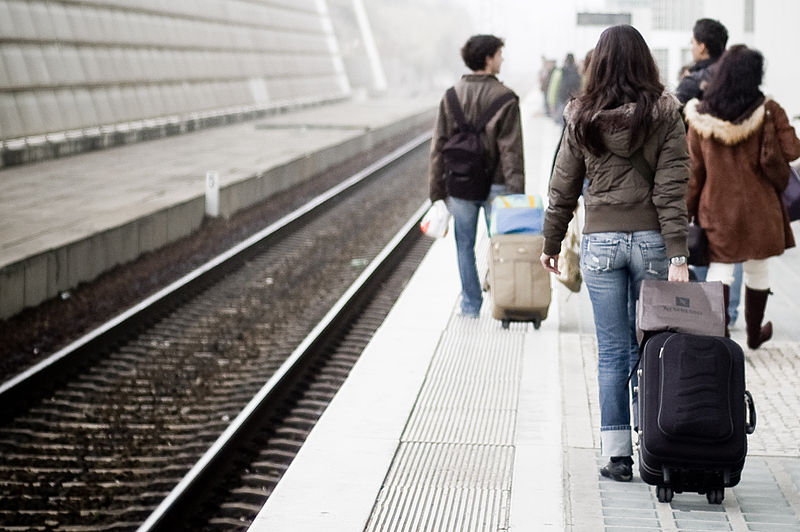
There was also an interesting incident connected with this. At that time, there was a direct bus connection between the Poštarski dom on Pohorje and the main train station in Maribor, which we used in both directions. Of course, the bus broke down on the way back, which caused us to miss the last express train to Ljubljana. When we arrived at the train station, the only available train was a regular passenger train, which left around 10:30 at night and arrived in Ljubljana only in the early hours of the next morning. Since our AIESEC members were not used to such "speed", this caused quite a bit of loud laughter and teasing among us, which was perhaps not the most friendly for the people around us. However, it attracted enough attention that two policemen, both with moustaches and very serious, soon approached our group. When asked who the leader was, I of course said so. I had to go with them to the police station, which was at the train station. Among the accusations I received there, the one that stuck in my mind the most was the accusation that by propagating the German language, we wanted to bring Hitler back to Maribor.
To understand the situation at that time, we need to know that English was rarely heard in public at that time, and therefore, especially in Maribor, many people were convinced that we were speaking German to each other – and very loudly. Therefore, the question is, what did the informant say about us that we then received such an unwelcome visit. After my lengthy demonstration that we reliably spoke only English in our group, the matter was finally somehow settled. But probably not completely. In the next compartment, we were escorted by two police officers, who stayed with us all the way to Ljubljana.
The next day, some of the trip participants left for their jobs late, and for most of them, I had to inform their companies that they would not be at work that day because they had spent the whole night traveling from Maribor to Ljubljana.
I admit that there were many other interesting things happening that year, which I certainly would not have experienced without AIESEC, especially given the circumstances at the time.
As an interesting fact, I should also mention that working in AIESEC at that time was considered the same as working in a work brigade when building a railway or road. The latter was one of the mandatory conditions for joining an international student exchange through AIESEC. This fulfilled the aforementioned condition for me, and the following year I was able to go abroad through AIESEC, specifically to the Siemens company in West Berlin. Since at that time the Yugoslav passport was one of the extremely rare ones that allowed completely unhindered passage between West and East Berlin, I was even able to watch the unusual start of the construction of the famous Berlin Wall live.
It is certainly a fact that AIESEC has long been present as an important factor in our connections of economics students with foreign countries.
Author: Milan Štruc, NCP 1959/60




 English
  Slovenian